


Welcome to Food for Thought
Here’s a roundup of the latest top stories from the College of Agricultural Sciences.
In this week’s Food for Thought roundup, we’re highlighting our dedication to developing the next generation of agricultural leaders through FFA and our seedstock and livestock judging programs, and exploring the contributions the college makes to interdisciplinary research, agricultural economics, and agricultural innovation.
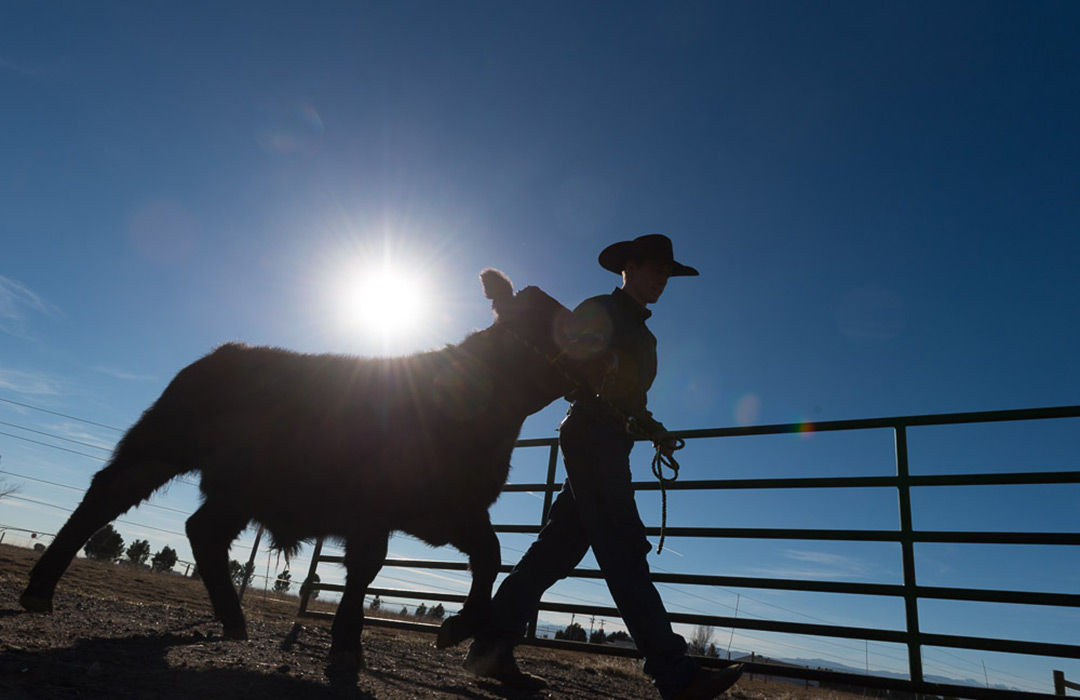
The Viewpoint with Samantha Cunningham
Samantha Cunningham, a fourth-generation Nebraska rancher, has dedicated her life to the beef industry. She began with livestock judging in 4-H and earned advanced degrees in animal breeding and science from Texas A&M University. Since joining CSU’s Department of Animal Sciences in 2016, she has led the nationally recognized Seedstock Merchandising and Management Program, where students gain hands-on experience in cattle management, genetic selection, and business operations.
“They’re succeeding because they leave here not just with technical knowledge, but with communication, leadership, and problem-solving skills. Those are things you can’t always teach from a book,” she says.
With a practical, science-based teaching approach and strong mentorship, Samantha has built a legacy of developing skilled leaders in agriculture.
Colorado State University hires new coach to revitalize livestock judging program
The CSU Department of Animal Sciences is proud to announce the next coach of the storied CSU Livestock Judging Team – Kase LeRow. Currently completing a master’s degree in ruminant nutrition at Texas Tech University, LeRow will assume the role on August 1, 2026, bringing with him extensive experience in livestock evaluation, competitive judging, and student mentorship.
“We know our partners across the state are excited to see this program take off. It’s also a great opportunity for Kase. It’s not often that someone gets the chance to build something so meaningful from the ground up. I’m excited to support Kase and the livestock judging team,” says Carolyn Lawrence-Dill, dean of the College of Agricultural Sciences.
CSU unveils new agrivoltaic system at its Western Colorado Research Center in Mesa County
At the CSU Western Colorado Research Center, a new experimental agrivoltaic system has been installed to study how solar arrays placed above vineyards impact grape growth and the feasibility of simultaneously producing solar energy and crops. Professor Horst Caspari highlights the importance of integrating agriculture and solar power to optimize land use and preserve valuable agricultural areas while supporting renewable energy production.
Temple Grandin portrait joins Smithsonian gallery
Temple Grandin, a world-renowned animal science professor, is honored in the Smithsonian’s National Portrait Gallery with a painting by David Lenz, as part of the Portrait of a Nation program recognizing transformative American contributions. Her portrait will be displayed from November 14, 2025, to October 25, 2026, before becoming part of the Smithsonian’s permanent collection.
Grandin is also the subject of a documentary film, An Open Door, now available on streaming services, as well as the HBO feature film, Temple Grandin.
How a corpse plant makes its terrible smell − it has a strategy, and its female flowers do most of the work
When Cosmo the Corpse Flower bloomed in 2024 at the CSU Plant Growth Facilities, it created a special chance for research across different fields. Atmospheric chemistry experts Delphine Farmer, Professor of Chemistry, Mj Riches, Postdoctoral Researcher in Plant-Atmosphere Interactions, and Rose Rossell, Ph.D. Student in Plant and Atmospheric Chemistry, studied the volatile organic and sulfur compounds responsible for the flower’s infamous odor, which mimics rotting flesh to attract pollinators. They measured how many of these chemicals the flower released and tracked how the emissions changed during the rare bloom. Their work gave new insights into the pollination strategies and biochemical processes of this endangered plant.
Tariffs have unsettled Colorado’s ag industry; a Trump suggestion adds to uncertainty
Colorado’s agricultural industry is facing mounting pressures from tariffs and the threat of increased beef imports from Argentina, raising concerns about market disruptions and the financial impact on Colorado ranchers. CSU agricultural and resource economics professor Amanda Countryman highlights worries over food safety, quality, and animal health due to Argentina’s different standards and history of foot-and-mouth disease.
A sharp 14% rise in beef prices from 2024 to 2025 is linked to a shrinking cattle herd, which has reached its third-lowest level in five decades because of drought and high costs. Countryman underscores the importance of rebuilding domestic cattle numbers, noting, “The U.S. is such a large beef consumer, and we’re so heavily dependent on domestic production, that we’re going to have to have a domestic supply response. It will take time.”
Halloween’s most infamous animals: Why spiders and bats don’t deserve their creepy, spooky reputation
Halloween is the season for all spooky and scary things – but spiders shouldn’t fall into those categories! Maia Holmes, director of CSU’s bug zoo, is working to fight arachnophobia by highlighting the ecological importance of spiders, including their contributions to nutrient cycling and pest control, while sharing fascinating facts about their silk’s unique properties and hunting strategies. Through education and outreach, Holmes hopes to help others appreciate these creatures for their silent yet essential contributions to the environment.
Sarah Matlock – Ram Talk Nov 11
Mark your calendar for November 11 and join Dr. Sarah Matlock to explore the science of equine behavior, and how a deeper understanding of their innate and emotional needs can reduce problem behaviors and fear-related issues. Drawing on principles from ethology, learning theory, and affective neuroscience, we will examine evidence-based practices in training and management that promote positive welfare, strengthen human–animal relationships, and encourage long-term behavioral resilience.
Dr. Matlock’s Ram Talk will be on Wednesday, Nov. 11 from 5 – 6:30 p.m. at the Fort Collins Welcome Center (7 Old Town Square, Suite 100— next to Coopersmith’s Pub and Brewing)
Eastern Colorado agriculture students compete in FFA State Range Judging event
The FFA State Range Judging and Plant Identification event, hosted on Oct. 8, brought together 255 high school agriculture students from 27 FFA chapters across southeast Colorado to develop their rangeland management skills through plant identification and ecological site assessments. Don Thorn, CSU Manager of External Relations for Rural Colorado spoke to students, emphasizing the value of agricultural education and FFA programs.