


Welcome to Food for Thought
In this week’s Food for Thought roundup, we take a closer look at how Maggie Murphy is building a winning program at CSU, along with how our researchers are working to combat the fungal disease threatening Palisade peaches. We also highlight standout flowers from CSU trials that you can find at local nurseries, plus a few of the best ways to enjoy Colorado’s vibrant wildflowers. While recent rain in Fort Collins has been a welcome boost, wildfire risk — and the rising cost of fighting fires — remains top of mind across the Mountain West.
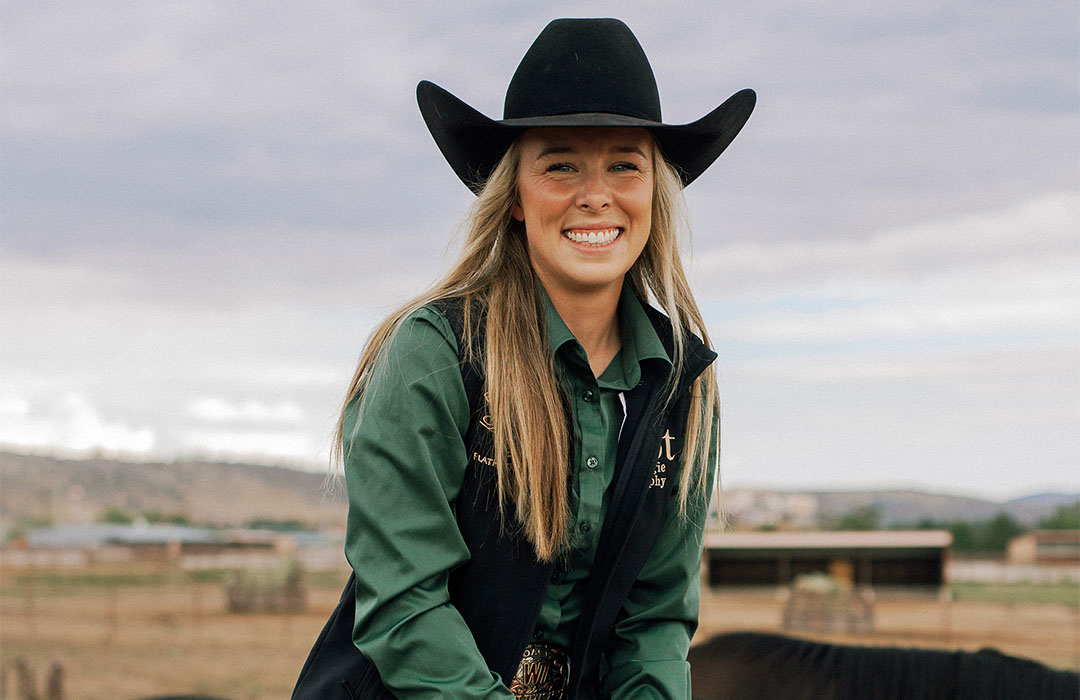
Jumping into the saddle: How Maggie Murphy builds winners in the arena and the classroom
After her first year as coach of the CSU horse judging and ranch horse teams, Maggie Murphy is building a program rooted in both competitive excellence and long-term student success — an effort that has also earned her national recognition as a member of the COWGIRL 30 Under 30 Class of 2026. Her goal is to develop students who are not only strong competitors, but also confident communicators, critical thinkers, and future industry leaders.
By emphasizing real-world skills, from decision-making under pressure to defending their reasoning, she prepares students for careers beyond the arena. That approach is already reflected in multiple top-10 national finishes and a historic fifth-place ranch horse team result.
“Judging is a privilege,” she says, “and with that comes a responsibility to lead with integrity, confidence and purpose.” Read More
Cargill’s lockout of 1,700 workers stopped beef production, sending ripples through the supply chain
Cargill has shut its doors to employees and ceased operations at its Fort Morgan plant, but according to Jennifer Martin, associate professor and meat extension specialist, consumers likely won’t feel the impacts — at least for now. When it comes to beef production, “any disruption and any impact on prices is going to take some time (to see) because of the way the industry is structured, which creates a bit of a buffer for many supply chain shocks,” she says.
While Cargill might be able to improve their bottom line by ceasing operations in Fort Morgan and shifting production to their other plants, Martin says that as long as transportation and fuel costs remain high, consumers shouldn’t expect to see it reflected in lower costs at their local supermarket. Read More
When times are hard, we eat more beans. And it’s happening again now
“Here’s a food that’s affordable. We don’t take advantage of it. It’s clear that it has health benefits… hey, America, wake up!” says Henry J. Thompson, professor of human nutrition and cancer prevention in the Department of Horticulture and Landscape Architecture. He’s talking about beans, which are inexpensive, packed with fiber and protein, and come in many varieties.
Thompson researches the health benefits of dry beans and explains that pulse crops help support the good microbes in our gut, which can help prevent disease. To get the most benefit, he suggests eating about 1.5 cups of pulses each day. “You go to Qdoba, and [they say] ‘Black beans or pinto?’… What do I always say? I’d like both, please,” he says. Read More
A fungal disease, along with climate change, threatens Colorado’s prized peaches
The Palisade peach is one of Colorado’s greatest summertime gifts. But cytospora canker poses a serious threat to Western Colorado’s fruit trees. These trees are especially at risk due to sudden freezes (common in the area), large temperature swings, and limited water. The disease usually gets in through wounds from pruning or weather damage and eventually kills the trees. Each year, it causes at least three million dollars in damage.
Researchers, including Jane Stewart in agricultural biology and David Sterle in horticulture and landscape architecture, have developed chemical treatments to help growers slow the spread of the disease. They are also studying resistant peach varieties and have established the cytospora working group to collaboratively develop solutions alongside researchers, extension specialists, and growers. Read More
As planting season starts, CSU Horticulture shares its picks for perennials from its trial garden
Spring has arrived, and the trial gardens have shared their annual list of the best-performing perennials. These plants come back every year. In the garden, perennials are planted over three summers and two winters, and those that survive are evaluated, and the top performers are chosen. According to Chad Miller, associate professor of horticulture and landscape architecture and program director, top performers usually have “higher average ratings of fours and fives on a scale of five, and higher survival rates of 85%-88% or higher over those three years.”
Take a look at the full report to see all the perennials that were evaluated. You can also visit the perennial garden, which is located in front of the Gregory Allicar Museum of Art in Fort Collins. Read More
7 breathtaking summer road trips that come alive with wildflowers
Colorado has no shortage of scenic drives, and when grasslands and high alpine meadows explode in shades of purple, pink, yellow, and every color in between, the state’s “Colorful Colorado” slogan makes sense. June and July are the peak times to view wildflowers in areas all over the state, including Estes Park, Grand Junction, and even Denver.
“One of the best ways to celebrate our diverse and beautiful flora in Colorado is to educate yourself about the sheer volume of plant species that live here,” says Jennifer Bousselot, associate professor of horticulture. Appreciate their beauty, but help protect both the wildflowers and the pollinators that depend on them by not picking them, even if they look like weeds. As the adage goes, “take only photographs and leave only footprints.” Read More
5 Garden Pests That Are Most Likely to Invade Your Yard This Summer — How to Keep Your Plants Safe
Hot summer weather provides the perfect conditions for plant pests to quickly multiply. Ada Szczepaniec, associate professor of horticultural entomology, says that an integrated pest management (IPM) strategy is the best bet for protecting plants from pests like aphids, whiteflies, and spider mites.
“Start with monitoring and correct identification, then decide whether control is actually needed, and use the lowest-risk effective options first… Combine prevention, monitoring, biological control, cultural practices, and selective products when needed to manage pests while reducing risks to people, pollinators, beneficial insects, and the environment,” she says. Read More
Wildfire risk is rising — as are the costs to fight them
As the Mountain West comes out of one of the warmest and driest winters in history, rain has been a welcome change here in Fort Collins. However, significant fires have already hit Nebraska and California and experts are worried about damage — both physical and financial. Jude Bayham, an economist in the Department of Agricultural and Resource Economics, says that while the federal government already spends about three billion dollars on wildfire suppression annually, the amount of money needed to fight fires will continue to grow as the number of wildfire-prone days increases.
“More fire will just mean more suppression costs,” says Bayham. Read More
STATE Magazine Spring 2026
This spring’s issue of STATE celebrates “the college that shaped Colorado,” and looks at how the Colorado Agricultural College (now Colorado State University) has shaped and continues to shape Colorado’s history. The College of Agricultural Sciences is featured in three articles:
- Reducing methane: Cattle contribute to climate change. How can that be solved?
- Soil moisture: Expanded system tracks and reports soil moisture across the state
- Beef sticks: CSU students help hungry Colorado kids
Read More
Trains, the plains and standing up Colorado’s ag industry
In 1908, Colorado didn’t have many amenities. But it did have potatoes and over 5,000 miles of railroad tracks. A partnership between the Denver and Rio Grande Railroad and Colorado Agricultural College brought the “Potato Institute Special” to the tracks, making 23 stops on its inaugural journey, which traveled as far west as Grand Junction.
But believe it or not, this wasn’t the first time the Colorado Agricultural College went on the road. On New Year’s Eve in 1879, just nine years after the college was founded, its three faculty members traveled by train and wagon to meet with farmers in the San Luis Valley. Although CSU Extension wasn’t officially established until 1914, these early efforts demonstrate our longstanding commitment to Colorado ag. Read More
Applause, Upcoming Events, and Announcements 🎉
- Beginning June 9, join Dean Carolyn Lawrence-Dill for Dean’s Office Hours, come-and-go gatherings in the Nutrien Building that offer a chance to ask questions, share ideas, or simply connect with the Dean. No agenda, just conversation and listening.
- Want to learn more about how integrated research, technology, management, and communication can support sustainable animal agriculture? Don’t miss the AgNext Research Summit June 3-4.
- The Colorado Livestock Association has named CSU alum Bill Hammerich the 2026 Top Choice Award recipient. Bill graduated with a degree in agricultural economics before advocating for livestock producers during his 20-year term as CEO of the Colorado Livestock Association. Congratulations, Bill!
- Congratulations to MJ Riches, Henrique Vieira, and Erin Burke, who were recognized for their inventions at the CSU Strata Demo Day poster showcase.
- The American Hereford Association has welcomed their summer interns – one of whom is Grace Stott, a junior studying animal science and Ag Ambassador. Grace will serve as a breed improvement intern, gaining real-world experience by completing day-to-day ranch operations as part of the National Reference Sire Program. Go Grace!
- Live from fruit and vegetable farms across Colorado: Nadia Henry! Nadia is a senior studying horticulture and will serve as a 2026 social media reporter for the Colorado Fruit and Vegetable Growers Association. She’s tasked with visiting farms and posting on social media channels to share the stories of Colorado fruit and vegetable farms and to let consumers know where they can purchase Colorado produce.