


Welcome to Food for Thought
This week in our Food for Thought roundup, we’re looking back on 2026 Ag Week and continuing to celebrate our alumni, students, and all the ways ag impacts our everyday lives. We’re also learning about our 4-H connection, why this year’s apple harvest is slim, and groundbreaking research on how irrigating crops helps prevent higher greenhouse gas emissions.
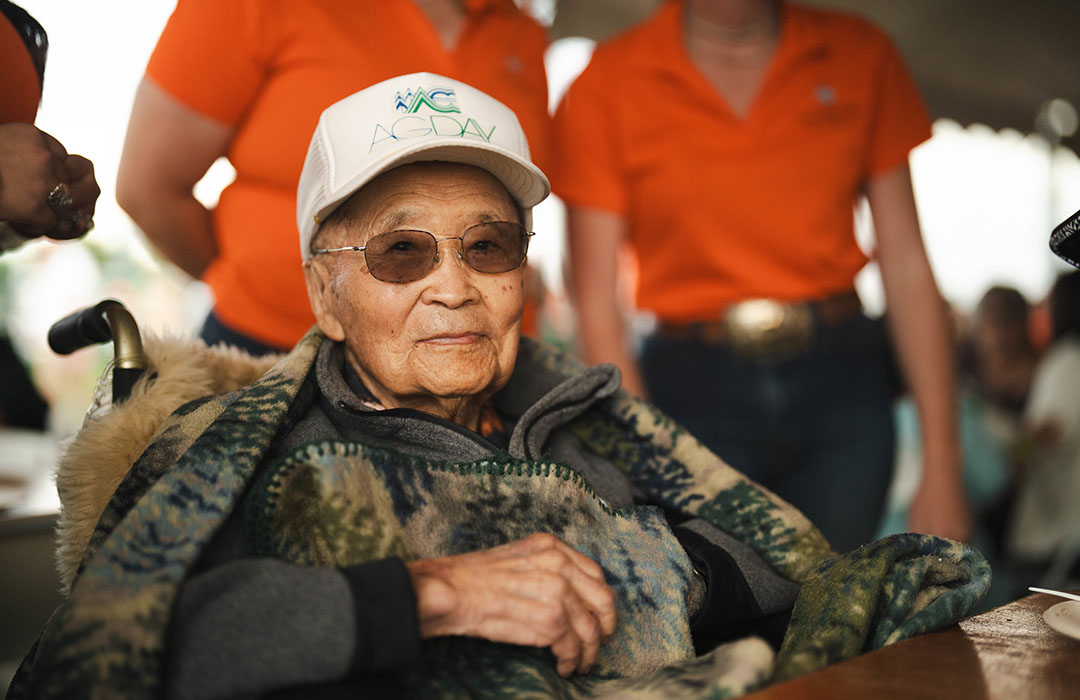
CSU Ag Day photos: Rams explode offensively to move to 2-0
Colorado State University celebrated 45 years of Ag Day on Saturday, bringing together generations of Rams for barbecue, live music and a celebration of our agricultural roots before the football team took the field at Canvas Stadium. The Rams Aggies had a 58-24 victory against Southern Utah. Be sure to check out the photos here!
Six inducted into Department of Agricultural and Resource Economics Hall of Fame
During Ag Week, the Department of Agricultural and Resource Economics honored six distinguished alumni and partners at its annual Hall of Fame banquet. The DARE Hall of Fame recognizes individuals whose careers, leadership and service have advanced agriculture, natural resources, education and public policy while reflecting the values and impact of the department. This year’s class includes recipients of the Lifetime Achievement Award, Early Career Award and Impacts Through Partnership Award. See photos from the event here.
- Julie M. Mueller, Lifetime Achievement Award
- Karl Skold, Lifetime Achievement Award
- Shannon Baylie, Early Career Award
- Billy Gascoigne, Early Career Award
- Michael Klamm, Early Career Award
- Tom Lipetzky, Impacts Through Partnership
Newell Kitchen honored as Department of Soil and Sciences Alumnus
Newell Kitchen ’90 was recognized by the Department of Soil and Crop Sciences during Ag Week at a ceremony alongside alumni, students, faculty and friends on Friday, Sept. 11. Kitchen earned his Ph.D. in Crop and Soil Sciences from CSU in 1990 and went on to become a leader in precision agriculture, with his research being published in more than 140 peer-reviewed journal articles during his career.
“What stands out most is his ability to turn complex research into tools that genuinely help farmers and strengthen our shared land-grant mission,” says Chris Pires, head of the Department of Soil and Crop Sciences. See photos from the event here.
Legendary livestock nutritionist John Matsushima honored with CSU facility naming
This year was a special year for the Animal Science Fall Gather during Ag Week. We celebrated Dr. John Matsushima’s outstanding career and service to the cattle feeding industry with the naming of the Dr. John K. Matsushima Livestock Research and Teaching Complex at the CSU Agricultural Research, Development and Education Center (ARDEC).
“Dr. Matsushima helped transform the field of animal nutrition through research that changed the way cattle are fed around the world. His pioneering work with steam-flaked corn helped shape feeding practices that continue to influence the livestock industry today,” says Dean Carolyn Lawrence-Dill. See photos from the event here.
Interactive exhibit celebrates global impact of the College of Agricultural Sciences
More than 70 stories highlighting the CSU College of Agricultural Sciences’ global impact are featured in the Nutrien Building through the Global IMPACT Map, an interactive exhibit and digital platform. Showcasing the college’s research, teaching, outreach and education activities around the world, the map allows visitors to explore international work through interactive filters and geographic storytelling.
Modeled after the CSU IMPACT(O) platform launched at CSU Spur in 2022 and developed by Greg Newman, Aryn Baxter and student Laura Richardson, the Global IMPACT Map serves as part exhibit, part website and part database.
“The stories remind us what we do and that it makes a difference,” CSU Chancellor Tony Frank said at the launch event during Ag Week. See photos from the event here.
Why land-grant universities are the backbone of 4-H: National 4-H Council CEO Jill Bramble and CSU student Ryer Roberts
More than a century after land-grant universities helped launch 4-H through agricultural youth clubs, CSU continues to support Colorado 4-H, which reaches nearly 100,000 young people across all 64 counties each year.
On The Next 150 podcast with CSU President Amy Parsons, National 4-H Council CEO Jill Bramble and Agricultural Education student Ryer Roberts explore 4-H’s evolution from its rural roots to its Beyond Ready initiative, which aims to prepare 10 million young people for careers, leadership, and life by 2030. Roberts, a junior from Fruita, is a former FFA and 4-H officer who now serves as Speaker of the Senate for CSU student government.
After two hard freezes, Colorado’s apple harvest isn’t looking very sweet
In April, the Western Slope suffered one of its worst freezes on record, hitting Hotchkiss and Paonia especially hard. An unusually warm winter caused trees to bloom early, and the freeze destroyed those blossoms, dealing a major blow to Colorado apple growers. Drought has added to the challenge.
“Orchard Mesa and Palisade will possibly lose their water in the next couple of days,” said David Sterle, research scientist at the Western Colorado Research Center, pointing out that these areas “never lose water.” Even when trees are not producing fruit, they need water to remain healthy and support future crops, particularly young trees with shallow roots.
Greenhouse gas benefits of ag irrigation outweigh emissions costs
Irrigating crops helps prevent higher greenhouse gas emissions by reducing the need to convert additional land for agriculture, according to groundbreaking research published in Proceedings of the National Academy of Sciences and led by Avery Driscoll, who conducted the study as a Ph.D. student in the Department of Soil and Crop Sciences. By enabling farmers to produce more food on existing farmland, irrigation reduces land conversion, a major source of agricultural emissions.
The study found that the additional land needed to make up for lost yields without irrigation would generate an estimated 363 times more greenhouse gas emissions than irrigation currently produces each year. “It was clear from this work that irrigation has a net positive effect on emissions,” said Driscoll.
Farmers and researchers are learning how to keep fertilizer out of pristine Colorado rivers
Researchers and ranchers are partnering to monitor water quality and stream temperatures in the Yampa and Gunnison basins. Led in part by the CSU Agricultural Water Quality Program, the effort is generating real-world data from working ranches to identify voluntary management practices that protect waterways, with growing participation from producers across the state.
While some ranchers were initially skeptical of possible government monitoring, many have since become advocates. “Early on I was doing a lot of cold calling, asking ranchers to participate. And a lot of them said, ‘Are you crazy?’ But now I would say 85% of what we’re doing is being driven by these producers. These ranchers have put themselves out there,” said Erik Wardle, director of the Agricultural Water Quality Program.
More calves, longer life: The real math of maternal heterosis
Supporting findings from the University of Illinois that crossbreeding improves both profitability and herd longevity, a separate lifecycle assessment by Greg Thoma, AgNext director for agricultural modeling and lifecycle assessment, modeled a 1,000-cow commercial Angus herd over a 10-year period under two breeding scenarios: Hereford bulls and Angus bulls. While Angus-sired calves were heavier at weaning, the Hereford-sired herd’s advantages in fertility, breed-back, and longevity resulted in 45,728 additional pounds of steers and open heifers available for sale over the decade.
Drought forces some Colorado ranchers to sell and ship cattle earlier than usual
Several years of drought have created significant challenges for Colorado ranchers, forcing some producers to reduce herd sizes or ship cattle earlier than usual as feed and water become harder and more expensive to secure. As streams and creeks dry up, some ranchers haul water daily and spend hours filling stock tanks, while ongoing drought conditions also contribute to hay and pasture forage shortages.
“Because that’s in a shortage, the cost has gone up,” said Jennifer Martin, associate professor of meat safety and quality. Rising feed costs can make it difficult for ranchers to maintain their entire herds, leading some producers to market cattle sooner than normal. “For Colorado, usually October, November is pretty common,” she said.
Southern Colorado’s tarantula migration: Where to watch and what to know
It’s tarantula season in southern Colorado. Most of the year, Colorado’s tarantulas remain hidden in underground burrows, but each fall mature males emerge in search of mates, sometimes traveling up to a mile in a single night. Maia Holmes, entomologist and education and outreach coordinator for the Department of Agricultural Biology, compares the journey to a human running a marathon. After performing courtship rituals at a female’s burrow, males must quickly retreat to avoid becoming prey. “It’s a bug-eat-bug world out there, so if that’s an option, a female will take it,” Holmes said.
These 6 greens will taste better if you wait until October to plant them, according to gardening pros
The Spruce As summer staples like tomatoes and zucchini fade from the garden, cooler temperatures create ideal conditions for leafy greens such as kale, spinach, and lettuce to thrive. Cold-tolerant crops often develop a sweeter flavor as falling temperatures trigger the conversion of stored starches into sugars.
“In colder conditions, plants do not [lose water] as quickly compared to crops grown in hot growing conditions, so fewer heat stress-related plant metabolites accumulate, which can cause greens to be bitter…leafy greens also rarely flower in cool conditions, and the changes associated with flowering can increase the bitter flavor of crops,” says Jen Bousselot, associate professor of horticulture.
Applause, upcoming events, and announcements 🎉
- CSU alums Anna Cawrse, Dale Kiyota, and John Paul “JP” Malik were honored during the Horticulture and Landscape Architecture Come to the Table event last week. Congratulations, Anna, Dale, and John – we’re proud to have you at our table! Photos here.
- Get ready to learn about the threat facing your carbs with Punya Nachappa, associate professor in the Department of Agricultural Biology, during this season’s Ram Talk Series on Nov. 18, just in time for Thanksgiving.
- The Colorado FFA Foundation has announced four Colorado Agriculture Hall of Fame inductees for 2027, including Jay Fletcher, Darrell Hanavan, Jeff Tranel and Gene Manuella.
- The CSU Alumni Association has announced Distinguished Alumni Awards for 2026, with Ed Eggers (B.S., agricultural business, ’78) receiving the CAS College Honor Alumni award.