


When defining what a traditional agriculturist looks like, you’re likely picturing farmers and ranchers of all ages and backgrounds.
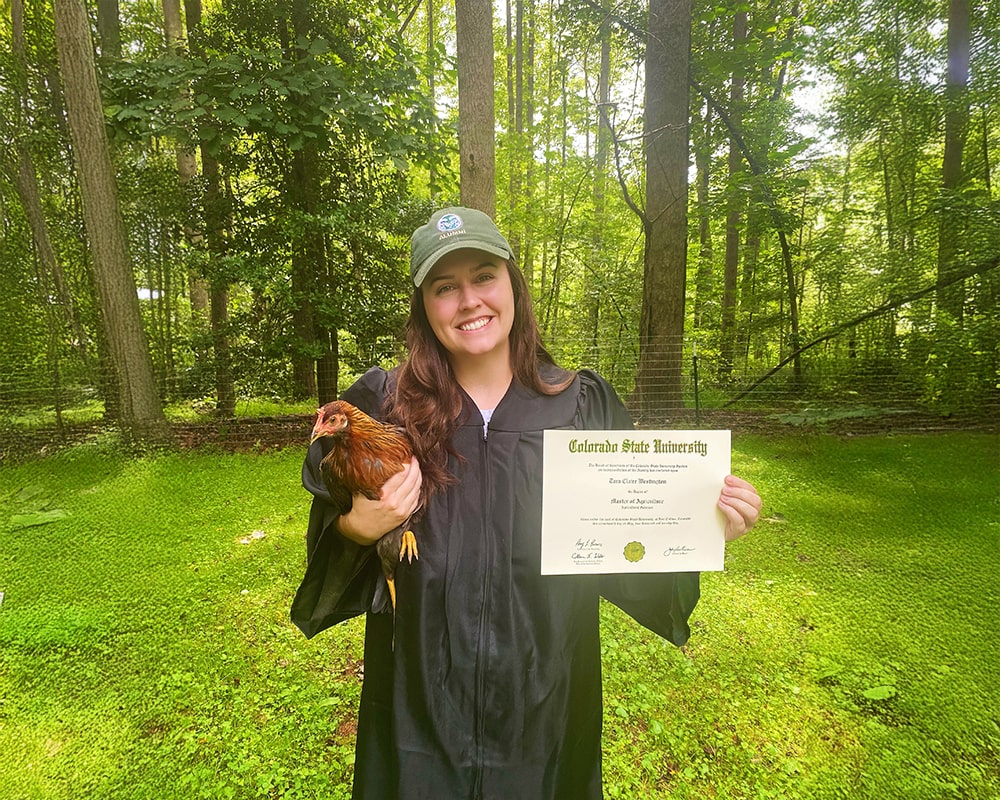
You’re definitely NOT thinking of Colorado State University graduate student Tara Westington.
Westington, you see, grew up in the suburbs of Connecticut. Other than catching fish and frogs in her backyard pond, her first real ag experience came when she worked on a local organic farm in high school.
“I did not come from a traditional background but I love ag and wanted to help make a difference,” she said. “I took my own path, and when I got to college I found that if I wanted to make impactful changes to really help the ag community it would have to be policy-related.”
And that’s how the non-ag kid from the suburbs came to work for American Farm Bureau Federation in Washington, D.C., where she spends her days advocating for farmers and ranchers. She’s the first to admit that her lack of an ag background can be detrimental, but she’s found ways to turn that perceived weakness into a strength.
“I learn from farmers and ranchers every day,” said Westington, an industry relations specialist with Farm Bureau. “We cover every issue under the sun, and I help bridge the gap between ag and non-ag audiences. I’m better able to grasp and translate those issues in a way that makes sense to whatever audience farmers and ranchers are engaging with.”
Not long ago, she was in Washington doing work for the American Farm Bureau Federation when a group representing CSU’s College of Agricultural Sciences, the Council for Agricultural Research, Extension, and Teaching (CARET) was meeting with Colorado legislators. CARET is an advocacy group, appointed by Dean Carolyn Lawrence-Dill, affiliated with the Association of Public and Land-grant Universities, that supports and promotes federal funding for land-grant university programs related to agricultural research, extension and higher education.
Westington came away from that chance meeting even more committed to her online master’s program.

“I wanted a program that was flexible with my work schedule and allowed me to work at my own pace,” she said. “CSU stood out because I didn’t want to specialize – I wanted to know a little bit about everything. And they do an amazing job of creating hands-on experiences in an online setting.”
Westington wasn’t on campus for her graduation this spring, but she did get the full CSU experience a few summers ago when she visited Fort Collins for the first time. She parked her car and started touring the campus on foot.
“When we got back to my car I saw a guy in a tow truck was hooking my car up to haul it away,” she said with a laugh. “I begged him not to tow me, and he let me off. That’s when I really felt like a real CSU student!”
To further her ag education, she and husband Robert recently purchased a 5-acre property near Beaverdam, Va., about an hour south of Washington, D.C. She’s already planned for a large garden and chickens, and hopes to utilize a small, wooded area for agri-forestry – a concept she learned about in her CSU classes.
“I love it out here,” she said. “The air smells so clean, and you can see a million stars at night.”
In the meantime, she’ll continue to advocate for the ag community.
“My main motivation is that I want to share the message that ag is for everyone,” she said. “You don’t have to be from a farming background to enjoy farming. The program at CSU has given me so much, and I really want to share that with other people so they can have the same experience.”
Written By – Tony Phifer


