


Parasitoid Wasps
Order: Hymenoptera
Family: Braconidae, Scelionidae, Ichneumonidae, Eulophidae, Aphelinidae, Trichogrammatidae
Description
The exact appearance of parasitoid wasps depends on the species. Most are extremely small (between 1-10 mm) and have brown or black bodies with long slender antennae. However, certain species belonging to the family Ichneumonidae can be over 10 cm (4 inches) long and have a very long ovipositor (egg-laying structure), while Trichogramma spp. are very small at 0.25-1 mm (1/25 inch) long.
In some species, the pupae are the most often observed life stage and appear as grains of rice on the surface of a host insect. Gardeners are more likely to see the results of parasitoid activity, such as aphid mummies, rather than the wasps themselves.

Giant ichneumon wasp. Image credit: Boris Hrasovec, Faculty of Forestry, Bugwood.org
Quick Facts
- Parasitoid wasps are highly diverse in size, and some can be extremely small and mostly unseen in their adult form.
- Parasitoid wasps tend to be specialists that attack a single host species. Eggs are typically laid inside of the host, and larvae feed and develop internally (endoparasite) or externally (ectoparasite) of the host insect. The pupae of some species develop externally and are visible on the host insect.
- Some wasp species, such as Trichogramma spp. and some braconid wasps, are commercially available as biocontrol agents for a variety of insect pests, most notably aphids and caterpillars. Certain conservation practices will improve their effectiveness, such as limiting the use of broad-spectrum insecticides, providing diverse floral resources, and allowing healthy and parasitized host insects to persist in the landscape.

Giant ichneumon wasp. Image credit: Steven Katovich, Bugwood.org

Parasitoid wasp attacking an aphid. Image credit: Frank Peairs, Colorado State University, Bugwood.org

Braconid wasp. Image credit: David Cappaert, Bugwood.org
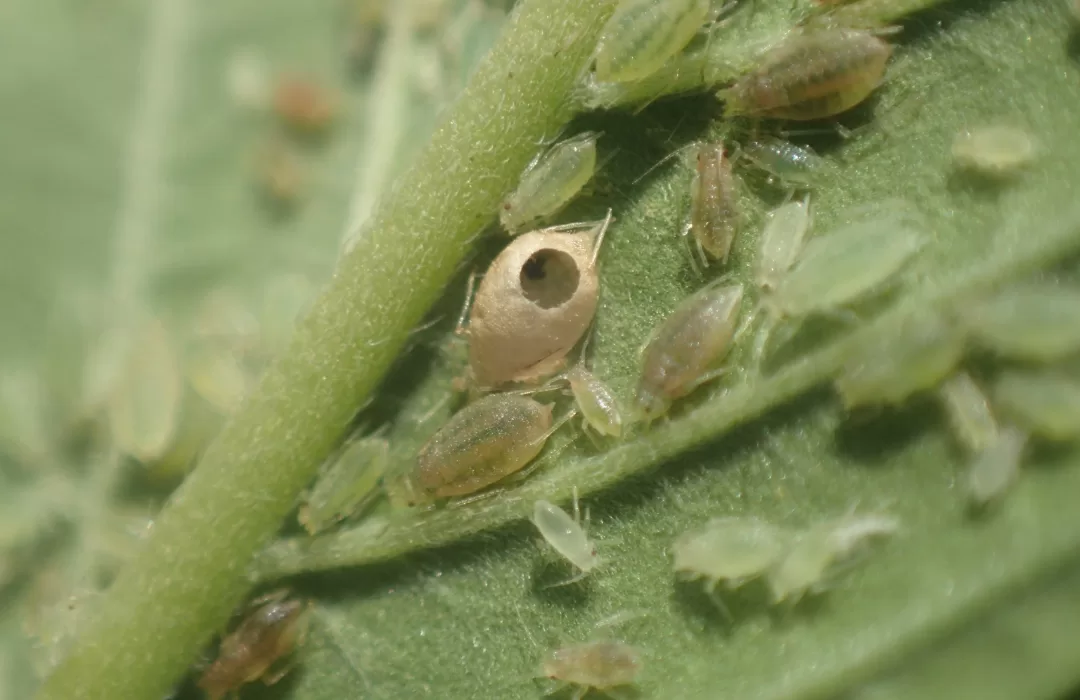
Aphid mummy with exit hole from braconid wasp. Image credit: Whitney Cranshaw, Colorado State University, Bugwood.org

Braconid wasp pupae on a caterpillar. Image credits: David Cappaert, Bugwood.org
Life history and habits
The exact life history of parasitoid wasps depends on the species, but most tend to be specialists that attack a single species of insect host. Collectively, parasitoid wasps attack various life stages of aphids, scales, psyllids, stink bugs, beetles, and caterpillars. Parasitized aphids typically turn brown or black and have a swollen, balloon-like appearance. After completing its development, the adult wasp emerges and leaves behind a round exit hole in the rear of the dead aphid, called an aphid mummy.
Usually, female wasps parasitize hosts by paralyzing an adult insect or larva and depositing eggs inside. Upon hatching, the wasp larvae feed within (endoparasite) or outside (ectoparasite) of the host. After pupating internally or externally of the host, the adult wasp emerges. Wasps that pupate externally often spin conspicuous pupal cocoons after emerging from a host. Adults generally feed on nectar, pollen, and honeydew, and in many cases, parasitoid wasps require floral resources for pollen and nectar to maximize their effectiveness.
Parasitoids as biological control agents
Several species of parasitoid wasp are commercially available for biological control of certain pests in fruits, vegetables, and ornamentals. One species, Aphidius colemani, is labeled for aphid control in greenhouses and outdoor growing systems. Various Trichogramma spp. are available for control of lepidopteran pests, including corn earworm, cutworms, cabbage looper, armyworms, borers, and codling moth.
In addition to these commercially available parasitoid wasps, naturally occurring populations of other species can effectively suppress populations of certain insect pests. Trissolcus spp. are important parasitoids of brown marmorated stink bug (Halyomorpha halys) eggs. The entire wasp development from egg to pupa occurs within the parasitized stink bug egg, which darkens as the wasp development progresses. One species in particular, the samurai wasp (Trissolcus japonicas), has been observed parasitizing up to 90% of brown marmorated stink bug eggs. Colpoclypeus florus is another species of parasitoid wasp that attacks caterpillars of lepidopteran leafrollers. In 1992, this species was observed parasitizing around 80% of leafroller larvae in unsprayed Washington apple orchards. In some instances, over 50 C. florus wasps can be produced from a single host. Maintaining natural populations of parasitoid wasps is possible through proper conservation practices.
Conservation
Parasitoid wasps are an important group of beneficial insects, but they often go unnoticed. The use of broad-spectrum insecticides should be avoided to help conserve these beneficial insects. The presence of diverse flowering plants with shallow flowers will provide food for parasitoid wasps. In addition, allowing certain insect pests to survive will help sustain naturally occurring populations of parasitoid wasps. Parasitized insects should be left alone to help support the wasp population. Maintaining leaf litter will also provide shelter for some wasp species.
References
Cannon, C., M. Murray., R. Patterson., and K. Wagner. (n.d.). Beneficial Insects of Utah. Utah State University – Extension. Available https://extension.usu.edu/pests/files/pubs/Beneficial-Insects-of-Utah-ID-Guide.pdf
MSU. (n.d.). Natural enemies – parasitoids. Michigan State University – College of Agriculture and Natural Resources. Available https://www.canr.msu.edu/ipm/uploads/files/WoodyLandscape_PDFs/NaturalEnemies_Parasitoids.pdf
Schuh, M. 2022. Parasitoid wasps. University of Minnesota – Extension. Available https://extension.umn.edu/beneficial-insects/parasitoid-wasps
UCANR. (n.d.). Trichogramma Parasitoids. University of California – Agriculture and Natural Resources. Available https://ipm.ucanr.edu/natural-enemies/trichogramma-parasitoids/
CSU Extension Fact Sheet
Download or view the CSU Extension’s PDF fact sheet for your reference.