


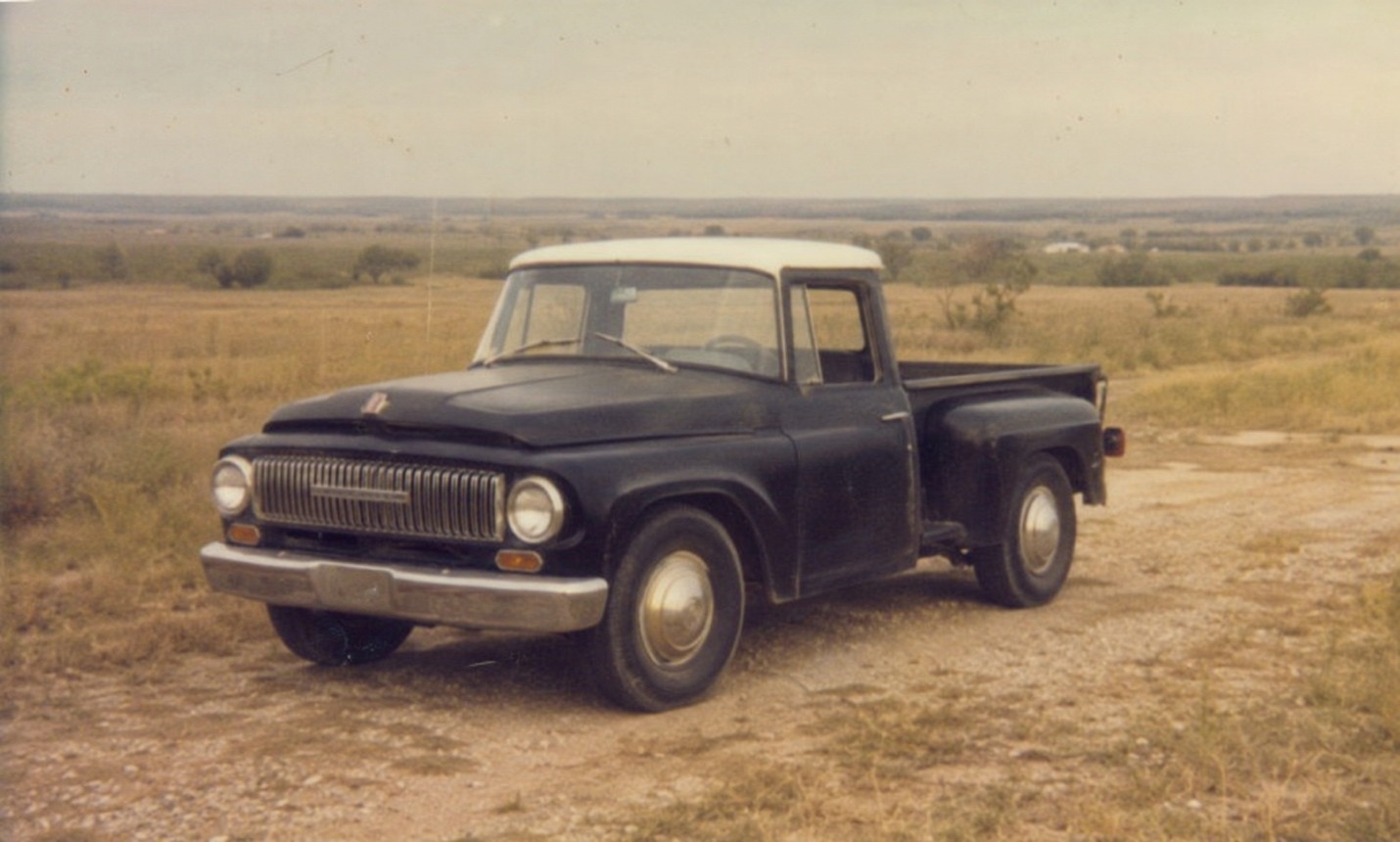
I learned to drive on a 1966 International with a four-on-the-floor transmission. You may ask: is that REALLY how you learned to drive? No—my first memories driving are of sitting in Dad’s lap when I could barely see over the steering wheel. On the highway, no less. He had his hand at the bottom of the wheel, and I had my hands at the top. I can still remember looking down at the bottom of that steering wheel and realizing I wasn’t really the one driving—it made me mad. But! When I was old enough to get a learner’s permit, it was that old black pickup that was my first vehicle, so I like to think it’s how I really learned to drive.
What was it like to drive that monster? The old black pickup was not subtle. When shifting, it didn’t politely suggest that the gears weren’t aligned. It told you.
Anyone who has driven an old manual transmission knows the feeling: the engine’s running strong, the drive gear is spinning fast, and yet nothing useful happens until the system is actually engaged. Push the clutch at the wrong time, release it too quickly, or try to force the shift, and the result is not momentum. It’s grinding.
That is not a bad way to think about leadership.
A college can have talented people, strong ideas, urgent needs, and plenty of motion. But motion is not the same as progress. Progress happens when the right gears engage: when research connects to communities, when Extension connects campus expertise with field-based needs, when policy conversations connect with science, and when students learn not only what to think, but how to deliberate, listen, and lead.
That is the work in front of us.
And importantly, this work ahead of us is not about launching a wave of new projects for the sake of newness. One of the central ideas in our Strategic Roadmap is that CAS is built on momentum, not expansion. The Roadmap does not ask us to abandon what is working or pile unrelated initiatives onto an already full plate. It asks us to align and accelerate the work already underway across the College.
Enrollment growth, research excellence, student career outcomes, interdisciplinary collaboration, and rural and global engagement are not theoretical aspirations. They are established trajectories in CAS. The opportunity now is to align them so that these parallel efforts compound rather than compete.
That’s the larger frame for the work ahead. Here I’m highlighting some roles that will help us to align: the Associate Dean for Extension Coordination and the Distinguished Fellow for Democracy in Agriculture.
Strengthening Extension, Partnerships, and Engagement
The College of Agricultural Sciences is launching a new Associate Dean role focused on Extension, partnerships, and engagement. This role is part of a broader collaboration model between CAS and the Office of Engagement and Extension, designed to strengthen CSU’s land-grant mission.
The reason for this role is straightforward. CAS has substantial Extension capacity, but it’s distributed across many faculty appointments, departments, programs, and priorities. Our current model includes 67 CAS/AES faculty with Extension funding: 16 with 10% or less Extension effort, 41 with 11-25%, and 10 with 25-50%. That distributed model brings real strengths, but it also creates coordination and alignment challenges.
When effort is spread widely, the College needs clearer mechanisms to ensure that priorities are aligned, investments are strategic, faculty are supported, and outcomes are visible. Without that, people can work incredibly hard and still feel like the system is spinning more than moving.
The new Associate Dean role is intended to help provide that coordination.
This position will work with OEE leadership, department heads, faculty, and Program Reporting Units to align priorities, support meaningful Extension appointments, and strengthen the connection between teaching, research, and Extension. The goal is not to move authority away from departments. The collaboration model preserves departmental responsibility for faculty appointments, workload allocation, and performance evaluation while strengthening system-wide alignment around Extension priorities, programming coordination, and impact.
That distinction matters.
The point is not to create more reporting burden. The point is to make the system work better: clearer roles, stronger shared metrics, better support for faculty, and more intentional investment in Extension work that serves Colorado. The model emphasizes joint priority-setting between CAS and OEE, coordination between the Associate Dean and OEE leadership, shared metrics tied to community needs and the land-grant mission, and mechanisms to address misalignment and adapt to changes in funding and stakeholder needs.
Over time, the model envisions a more structured Extension ecosystem within CAS, including 5-10 cornerstone faculty with 50% Extension appointments, 20-30 faculty with at least 25% Extension appointments, renewable roles aligned to priorities, sabbatical lines, operational and travel support, competitive seed grants, structured onboarding, and mentoring.
This is a good example of building on momentum rather than expansion. CAS already has Extension talent. We already have faculty doing meaningful work across Colorado. We already have partnerships, programs, and community-facing expertise. The Associate Dean role is not meant to create a separate lane beside that work. It is meant to help existing efforts engage more effectively with one another, with OEE, and with the communities we serve.
The role is intended for a tenured full professor. Anyone interested in learning more about the position or potentially applying for consideration should reach out to Allan Andales, who is chairing the process, and/or Mark Uchanski, who is serving as co-chair. The rest of the committee includes Kellie Enns, Stephen Koontz, Jennifer Martin, Eric McPhail, and Ada Szczepaniec —thank you all for your service on the committee!
The aim is to build a stronger pathway into and through Extension work—not by forcing engagement, but by making engagement easier, more coherent, and better supported.
In transmission terms: we already have power in the system. The opportunity now is to improve engagement so that power becomes motion.
Launching a Distinguished Fellow for Democracy in Agriculture
We’re also launching a Distinguished Fellow for Democracy in Agriculture. This role (outlined in the Strategic Roadmap) will focus on connecting science, policy, and civil discourse at a time when agriculture is central to many of the hardest public conversations we face.
Water. Land use. Food systems. Livestock. Climate. Rural economies. Energy. Biotechnology. Public trust in science. These are not just technical issues—they are civic issues. They require evidence, but evidence alone is rarely enough. They also require listening, deliberation, humility, and the ability to work across difference.
The Distinguished Fellow will help CAS build capacity at that intersection. The goal is to support a college culture where scientific expertise is connected to public problem-solving, and where students learn to engage complex agricultural issues with both intellectual rigor and civic responsibility.
This work also reflects the Roadmap’s emphasis on alignment. CAS already has deep strengths in agricultural science, economics, Extension, community engagement, and student learning. The Fellow role gives us a way to connect those strengths more intentionally to policy, public deliberation, and civic leadership.
This work also creates an important opportunity to connect with one of CSU’s newest land-grant assets: former U.S. Secretary of Agriculture Tom Vilsack, who has joined CSU as a Board of Governors Land-Grant University Fellow. Secretary Vilsack brings extraordinary experience in federal food policy, rural communities, agricultural markets, and public service. His presence at CSU gives CAS a rare opportunity to connect students and faculty with national-level policy experience in a way that is practical, applied, and deeply aligned with our land-grant mission.
Faculty interested in the Distinguished Fellow for Democracy in Agriculture opportunity can find more information on the college website by going to Faculty Resources and selecting the link for Dean’s Leadership Fellowships. Applications are due July 31, 2026 (submit via email to me, copy Shannon Wagner), with department heads and assistant and associate deans giving input on applications before I select an appointee from the group of applicants. In addition to what candidates write up that they are interested to accomplish, the Fellow will guide work to…
…Build a Certificate in Agricultural Policy and Civic Leadership
One early opportunity is the development of a Certificate in Agricultural Policy and Civic Leadership. The concept is to connect existing strengths in the College with new programming that prepares students to understand agricultural issues, engage policy questions, and participate constructively in public life. That’s also outlined in our College’s Strategic Roadmap.
A key anchor for this work is AREC 380: Agricultural Issues, taught by Dawn Thilmany, professor of agricultural and resource economics and co-director of CSU’s Regional Economic Development Institute. Dawn’s course already creates a foundation for helping students examine current issues in agriculture and food systems.
That foundation could be expanded through connection with Secretary Vilsack’s new one-credit course, Dynamics of Ag and Food Markets and Policy, a new AREC course co-taught with Dawn. The course focuses on federal food policy, mechanisms for supporting rural communities, and practical approaches to solving agricultural and food system challenges. Students learn from Vilsack’s experience leading USDA, engage with national policy experts, examine pressures facing farmers and ranchers, and develop policy solutions aimed at supporting producers, food systems, and rural communities.
That is exactly the kind of learning experience that should sit at the heart of an Agricultural Policy and Civic Leadership certificate.
The certificate could also connect with CSU’s Center for Public Deliberation, giving students tools for civil discourse, facilitated dialogue, democratic engagement, and constructive disagreement. Agriculture needs leaders who can understand the science, read the economics, respect the lived experience of communities, and still stay at the table when the conversation gets hard.
Ideally, the Distinguished Fellow for Democracy in Agriculture would help lead this certificate effort in close collaboration with Dawn, Secretary Vilsack, the Department of Agricultural and Resource Economics, the Center for Public Deliberation, and other faculty partners across CAS.
Again, this is not expansion for expansion’s sake. We are not starting from zero. We are connecting pieces that already exist: an established agricultural issues course, a new policy-focused course with Secretary Vilsack, Dawn’s expertise in agricultural economics and regional food systems, the Center for Public Deliberation’s strengths in civic dialogue, and CAS’s broader land-grant mission.
This is the gear alignment we need: faculty expertise, student learning, public deliberation, agricultural policy, Extension capacity, and civic leadership working together instead of spinning separately.
Why this matters now
Agriculture has always required practical knowledge. But today’s agricultural leaders need something more. They need to understand science, economics, policy, communication, and public trust. They need to know how to make decisions when the facts are complex, the stakes are high, and the room is not in agreement.
That is not a niche skill. That is leadership.
As we build these new roles and programs, we have a chance to strengthen how CAS shows up as a land-grant college. We can be more connected to Colorado. We can be more useful to our partners. We can give students better preparation for the real world they are entering. And we can model a form of engagement that is serious, respectful, evidence-based, and brave enough to stay in hard conversations.
The Strategic Roadmap asks us to align and accelerate work already underway. That is the point here. The new Associate Dean role, the Distinguished Fellow for Democracy in Agriculture, and the proposed Certificate in Agricultural Policy and Civic Leadership are not separate initiatives competing for attention. They are connected efforts that help CAS do what a modern land-grant college must do: bring science, education, Extension, policy, and public engagement into better working relationship.
Learning to drive that 1966 International taught me that power and motion are not the same thing. The engine could be working hard, but until the gears engaged, that truck was not going anywhere. And when I tried to force engagement without understanding the clutch, the truck let me know. Loudly.
That lesson has stuck with me. Leadership is not just about generating energy, naming priorities, or spinning faster. It is about creating the conditions for engagement—aligning the gears, using the clutch wisely, and helping the power already present in the system become forward motion.
The engine is running. The gears are there. The next step for us is to engage even better.
Dean’s Leadership Fellow Spotlight
This month, I am pleased to highlight the work of Sarah Ehrlich through the Dean’s Leadership Fellows program.
Sarah Ehrlich’s Dean’s Leadership Fellowship project strengthened CAS visibility and impact at the state Capitol by organizing a coordinated college presence that enabled students, staff, and faculty to sign up, show up, and create a stronger splash for the College than in past years. Through this effort, CAS ambassadors shared CSU’s work in agricultural research, Extension, food security, sustainability, regenerative agriculture, climate resilience, water stewardship, and food systems. Timed for the legislative session, the project helped policymakers better understand the College’s statewide land-grant contributions while giving ambassadors hands-on experience in science communication, civic engagement, and policy-facing leadership. This work directly supported the CAS Strategic Roadmap by advancing public impact, statewide engagement, student success, and the College’s role as a trusted partner for Colorado.
Want to take on a role to advance a project? Here’s the application form.
You Said, We Did
Earlier this year, we gathered the folks in our college that have been trained through Lead21, FSLI, and HFP Consulting. Of those, our largest cohorts are in HFP, and alums from that program map to all the departments and units across the College and AES.
You said: When that group of trained leaders gathered, there was a strong interest for our CAS Leadership Team (CLT) to get trained by HFP given that so many across the College already know the concepts taught. Why not align the leadership thinking so that we’re all speaking the same language as an aligned organization?
We did: Following those discussions, we hatched a plan for the CLT Fall Retreat. We’re now finalizing a day of training by HFP in August and will report out on the ‘aha’ moments that happen as we infuse their concepts into how we lead at all levels in the College of Ag Sciences.
Who’s a part of the CLT and what’s their mission? It’s the Dean, Associate and Assistant Deans, and Directors across our College. Current membership in the CLT includes:
- Ryan Brooks – CAS Representative, Faculty Council Committee on Non-Tenure Track Faculty
- Amy Charkowski – Associate Dean, Research and Graduate Education
- Hayley Chounard – Department Head, Agriculture and Resource Economics
- Tyson Claffey – Director, IT
- Kerri Conway – Director, International Agriculture
- Patrick Doyle – Department Head, Animal Sciences
- Kellie Enns – Associate Dean, Academic and Faculty Affairs
- Jessi Fuentes – Executive Director, Finance
- Anna Gerber – Director, Communications
- Joanna Holiday – Director, Human Resources
- Gene Kelly – Director, Agricultural Experiment Station
- Jordan Kraft Lambert – Director, Ag Innovation and Partnerships
- Brendan McCrann – Managing Director, Development
- Chris Pires – Department Head, Soil and Crop Sciences
- Noa Román-Muñiz – Department Head, Agricultural Biology
- Quatez Scott – Assistant Dean, Access and Success
- Dawn Thilmany – Interim Department Head, Horticulture and Landscape Architecture
- Don Thorn – Director of External Relations, Rural Colorado
- Shannon Wagner – Executive Assistant to the Dean
The mission of the CAS Leadership Team is to coordinate across units, strengthen shared practices, and support our teams in advancing meaningful impact across research, education, Extension, and service. Through collaboration, communication, and aligned leadership, the team helps connect people, resources, and ideas across the college to better serve Colorado, the agricultural sciences, and the land-grant mission.
Food for Thought
Food for Thought brings together the stories that shape the College of Agricultural Sciences. From science and technology to education and culture, our faculty, students, and staff are making a difference everywhere you look.
Dean’s Office Hours
Join me this summer and fall to ask questions, share ideas, or simply connect. These are come-and-go office hours—stop by the Nutrien building anytime during the session. For one-on-one conversations, contact Shannon Wagner to schedule. The next Dean’s Office Hours are Thursday, July 9, from 10 a.m. to 12 p.m.