


Welcome to Food for Thought
Here’s a roundup of the latest top stories from the College of Agricultural Sciences.
In this week’s Food for Thought roundup read about how farmers in rural areas are working to make ends meet and how SNAP benefits are affecting their communities, how cold hardiness data is helping farmers grow better crops, and how Fort Collins serves as a hub for the USDA and all things agriculture.
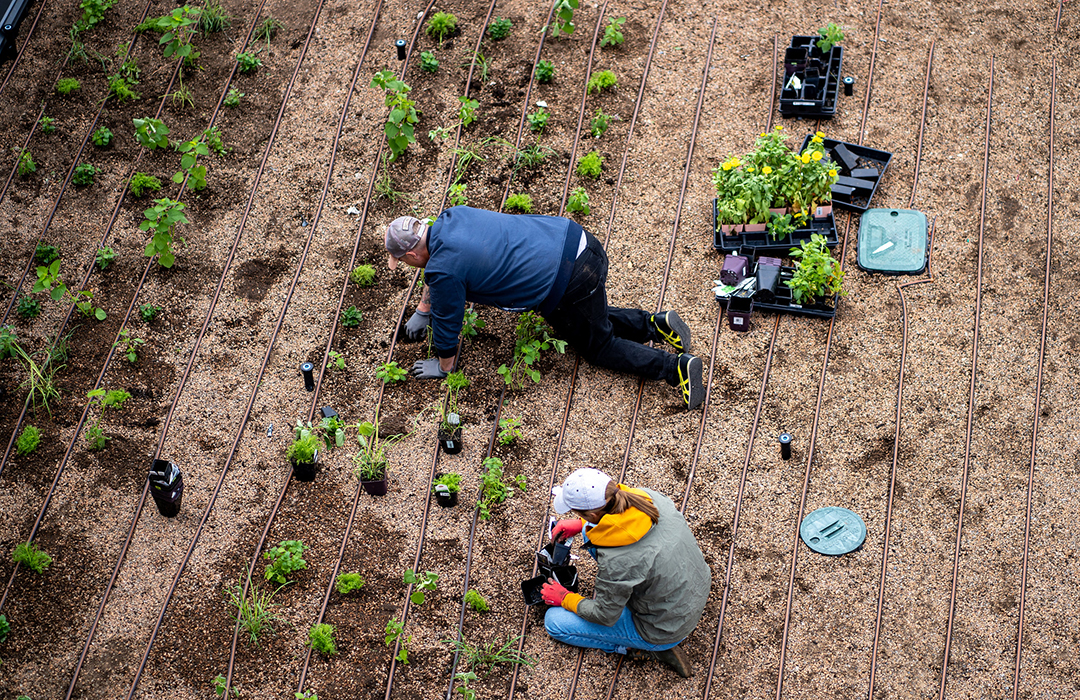
2 ways you can conserve the water used to make your food
As climate change increases drought and water shortages, researchers at Colorado State University are exploring ways to conserve water in agriculture. Huma Tariq Malik, a Ph.D. student in Soil and Crop Sciences, and Thomas Borch, Professor of Environmental and Agricultural Chemistry, are studying how to make irrigation more efficient, improve soil health, and use less water throughout the food supply chain. Their research shows that both farmers and consumers can help manage water more sustainably. Two ways that the everyday consumer can help? Reduce food waste and meat consumption.
Cold-hardiness model could be breakthrough for farmers
Ionnas Minas, CSU Associate Professor of Pomology, has developed a tool that could be a game-changer for peach growers. At the Orchard Mesa research center in Palisade, Colorado, Minas and his team have developed a cold-hardiness model to help peach growers assess bud survival based on growth stage and real-time weather conditions. Following years of research and thousands of freezing tests, the tool, currently being piloted in five locations, provides accurate risk predictions to support frost management. “So far, all of our farmers have been very, very excited, and happy, and engaged with this program,” says Minas.
How to get America’s kids to the ag table
Manny DeLeon didn’t grow up around agriculture, but now, as Technical Research Lead for the CSU Agricultural Water Quality Program, he works with farmers and the Colorado Department of Agriculture to use technology for water quality monitoring and analysis. With labor shortages becoming a bigger issue in agriculture, Rachel Gabel, assistant editor of The Fence Post Magazine, says it’s more important than ever for the industry to attract people like DeLeon. “Agriculture needs people to connect in a way that reminds them, despite some headlines, the industry and the people who feed, fuel and clothe America daily are still good,” she writes.
Temple Grandin is being honored by the Smithsonian – but she says her work is far from complete
Temple Grandin, professor of animal sciences at Colorado State University and a leading advocate for autism awareness and humane livestock practices, will have her portrait displayed in the Smithsonian’s National Portrait Gallery as a 2025 Portrait of a Nation Award honoree. While celebrated for her contributions, Grandin emphasizes her mission to inspire students to explore opportunities and pursue meaningful careers.
One more time: Farmers and ranchers are major SNAP beneficiaries too
During the recent government shutdown, the White House reopened Farm Service Agency offices to distribute $3 billion in farm aid, but delayed $8 billion in SNAP benefits for 42 million Americans. CSU agricultural economist Dawn Thilmany says that SNAP spending strongly supports rural economies, with up to 25% of those dollars going back to farmers and ranchers, a figure that may be even higher when accounting for purchases at farmers’ markets and local food retailers.
How urban farms can make cities more livable and help feed America
Rooftop agrivoltaics pairs solar panels with crop production, helping urban areas reduce water loss, lower energy costs, boost food security, generate clean energy, and create climate-resilient green spaces. At CSU Spur in Denver, horticulturist Jennifer Bousselot has found that many crops – from heat-loving zucchini to finicky saffron – thrive atop rooftops.
“We’re essentially creating a microclimate, very much like a greenhouse, which is one of the most optimal conditions for most of our food crops to grow in, but it’s not a system that needs heating or cooling or ventilation, like a greenhouse does,” she says.
Fort Collins as one of USDA’s regional hubs — ‘it began to make sense’
The USDA has selected Fort Collins as one of five new USDA regional hubs as part of its reorganization efforts, along with Kansas City, Indianapolis, Salt Lake City and Raleigh, N.C. The move is designed to bring the USDA closer to its customers, according to Agriculture Secretary Brooke Rollins. “We have a very long history of partnership with the USDA. There are a lot of USDA facilities already on the CSU campus. We think this really is an opportunity to deepen our relationship with the USDA and many of their agencies,” says Cassandra Moseley, CSU’s vice president for research.
Feeding Hard-Keeping Horses
In equine nutrition, horses are classified as easy, hard, or average keepers, based on how they gain and maintain weight. These terms, however, are relative according to Devan Catalano, CSU assistant professor of equine science and equine extension specialist. She explains that keeper status is more about disposition than breed. “If you have a more anxious, higher-strung horse that is naturally exerting more energy, they’ll tend to be a harder keeper than a relaxed, mellow horse that just stands in the field.”
Student research aims to protect water, livestock and livelihoods
Every summer, CSU students gain hands-on, interdisciplinary learning experience through the Extension internship program, where they help solve real problems in local communities. Daniel Seffah-Duodu, an electrical engineering PhD student, used drones to gather data that would ultimately help farmers optimize their water usage. “For students curious about where technology meets real-world impact, Daniel’s experience shows just how far you can go,” says Perry Cabot, Extension professor and research scientist at CSU’s Western Colorado Research Center.
Horse, of course: What are the effects of equine-assisted services on four-legged participants?
Cristal Morales Chavez, a senior in equine science, spent her summer at the CSU Spur Temple Grandin Equine Center in the OURA program, helping uncover what therapeutic riding means not just for kids with autism – but for the horses who carry them!
“It felt unique to be part of research that is really pioneering a field,” says Morales Chavez.
Findings from the study are expected in the coming months and will offer equine-assisted service professionals valuable insight into how to keep their therapy horses healthy, comfortable and ready to work. After all, these horses are true partners in the process. And when a horse isn’t at its best—or isn’t responding well to a rider—the experience simply isn’t as effective as it could be.