


Reflections on Fall 2025
December is a wonderful time to pause, reflect, and celebrate all that we have accomplished together. The second half of 2025 has been an especially meaningful and productive season for DARE, and I am deeply grateful for the dedication and hard work of our students, staff, and faculty. What an extraordinary community of talented and committed professionals. During this semester, we were fortunate to collaborate with a wide range of incredible partners who helped advance our research, teaching, and outreach mission areas in impactful ways. Their engagement and support made it possible to achieve outcomes that truly matter. Please keep reading to learn more about the amazing things happening in DARE. We hope to catch you at the National Western Stock Show in January where DARE faculty, staff and students will play an integral role in telling the story of agriculture, creating hands on experiences, and promoting all our industry has to offer! Happy holidays and all the best for 2026!

DARE Highlights
DARE Research in Katmai National Park, Alaska: In July, DARE faculty member, Lynne Lewis and Graduate student, Jayna travelled to Katmai National Park in Alaska, home of the largest protected brown bear population in the U.S. Here, they conducted a visitor experience survey, getting responses from over 850 visitors from around the world. They are using the data from the survey to create a report for the National Parks Service regarding perceptions of crowding and safety in the area. In their free time, they kayaked on the lake, watched bears fish in the river, talked with park rangers and visitors, and took thousands of pictures.
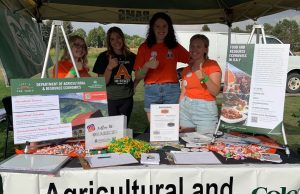
CAM’s Ag Academy on the Road: Our AGED team traveled to 5 county fairs- Weld, Fremont, Routt, Archuleta, and Moffat counties and both weekends of the Colorado State Fair. During these travels, the CAM’s team interacted with more than 4,400 people at CAM’s Classroom, where studentcreated and student-led activities educate visitors on different agricultural subjects. There were over 320 people who earned their Junior Ag Ambassador badge by completing an in-depth activity about the agriculture in their county. In addition to a physical presence at the fairs, CAM’s, in partnership with COAITC and OEE, sent agricultural outreach kits to 4 intermountainregion counties.
Todd Everhart joined DARE as an Affiliate Faculty Member: Todd Everhart joined DARE as an Affiliate Faculty member this fall. He has been teaching courses in our Agricultural Education program and has collaborated with DARE to increase our undergraduate recruiting efforts.
Involvement Fair: We had over 60 students attend the 2025 Involvement Fair to learn about all things DARE and how to get involved.
Ag Week: During Ag Week 2025, we proudly celebrated our Aggie roots. Our DARE students, staff, and faculty actively engaged in promoting our programs. We had several students and faculty assist at numerous events, including Ag on the Plaza, and the CAS Quiz Bowl cohosted by DARE on September 4. The week wrapped up with our Legendary Owl Ceremony and Blue Jacket Society breakfast where we celebrated our Legendary Owls and Blue Jacket Inductees. Our very own Kellie Enns was inducted as a Legendary Owl! Following the banquet was the 44th Annual Nutrien Ag Day BBQ where we interacted with alumni, friends, and industry partners. To learn more about events happening in the College of Agricultural Sciences you can always visit the CSU College of Agricultural Sciences Events page.
DARE Networking Mixer: This fall’s mixer was one of our biggest yet, with 10 booths/employers, over 70 students in attendance,
and many alumni and industry partners. Thanks to all who attended. If you are interested in learning more about getting involved, please contact Aubriel Zachman (Aubriel.jones@colostate.edu). Our next mixer will be February 2026!
2025 National FFA Convention: We had many DARE students and faculty attend the 2025 National FFA Convention. Congrats
to all who participated and received awards!
RAISE Scholars Assess Winter Pea Quality: This fall, DARE’s RAISE Scholars are getting hands-on experience: figuring out whether winter peas could be a profitable, water-friendly crop for farms in the Colorado River Basin. In the photo, you’ll spot undergraduates Jason Delfico and Nicolette Marty sorting fallplanted peas grown at CSU’s Western Colorado Research Center near Fruita by size, shape, and color to see where they might fit in the marketplace under USDA Agricultural Marketing Service standards. Fellow scholars Isabella Cogdill and Brooklynn Henschel are also contributing to the project, though not pictured. Why the attention on quality? Because in water-limited agriculture it’s not only how much you grow, but also how good it is, that opens doors to better marketing channels. The RAISE Scholars are guided by Daniel Mooney, Associate Professor in DARE, and, for this project, a fantastic CSU pulse team: Jess Davis (Pulse Agronomist), Marissa Spear and Bill Szasz (Research Associates), Perry Cabot (Water Engineer), and Todd Ballard (Extension Specialist). Learn more
Dynamics of Ag and Food Markets and Policy: In 2025, we successfully piloted “Dynamics of Ag and Food Markets and Policy,” a unique course co-taught by former USDA Secretary Tom Vilsack, DARE Professor Dawn Thilmany, and DARE graduate student Rebecca Wasserman-Olin. This interactive course helped students understand the development of policies that support agriculture, rural communities, and the environment. Throughout the semester, students built professional leadership skills by engaging directly with realworld policymakers. The course concluded with a final session where students presented convincing arguments or proposals on their policy of choice.
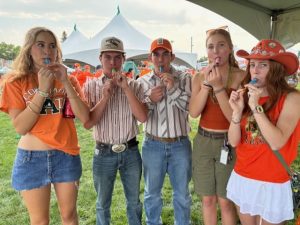
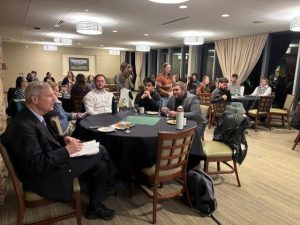
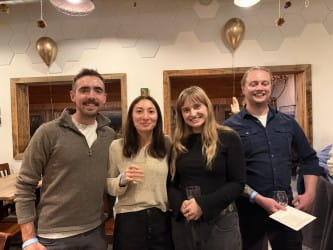
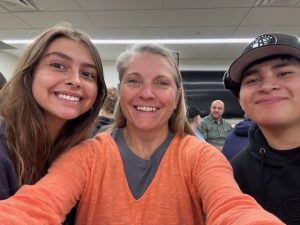
DARE Introduction to Agribusiness Entrepreneurship: This semester in AREC 224 (Introduction to Agribusiness Entrepreneurship), students were paired with an agribusiness leader or food entrepreneur and worked with their mentor throughout the term to produce a podcast episode and compete in a culminating business case competition. With generous time and guidance from our mentors, students gained hands-on experience translating real-world challenges into clear decisions and recommendations. The podcast series will be hosted on the College of Ag Science’s YouTube channel, extending these stories and lessons beyond the classroom. Looking ahead, this course will count toward CSU’s Entrepreneurship Certificate, so students who want to continue can build on this foundation by completing two additional entrepreneurship courses in the College of Business. Photos feature students and mentors who gathered for the Agribusiness Entrepreneurship Business Case Showcase & Networking Event in December.


DARE Work in the Media
Research and Publications
Lynne Lewis’s research on bad behavior in National Parks: The Celebrity Effect: How Famous Wildlife Can Lead to Risky Behavior (U.S. National Park Service)
Dan Mooney’s interview with the Colorado Sun: Colorado River water conservation program is stalled in US House.
Nate DeLay’s article in AJAE examining the market for crop insurance agents: Agricultural & Applied Economics Association (AAEA)
DARE AGED member featured on Good Morning America- Dessa Waston and her amazing furry friends were feature on national TV, watch here!
Check out this important article on policies impacting groundwater conservation done by DARE faculty Jordan Suter and Chris Goemans. Abatement subsidies for groundwater conservation – Rouhi Rad – American Journal of Agricultural Economics – Wiley Online Library
DARE faculty member’s, Marco Costanigro, Josh Berning, Jude Bayham and Nathan Palardy (CSU Ph.D) article in the “Applied Economic Perspectives and Policy”. Changes in Alcohol Retail Laws and Foot Traffic at Liquor Stores – Palardy – Applied Economic Perspectives and Policy – Wiley Online Library
Article co-authored by DARE members, Sionegael Ikeme, Amanda M. Countryman, Dale T. Manning- Quantitative Comparison of Ad‐Valorem Equivalents for Non‐Tariff Trade Measures: WTO Versus TRAINS
Lauren Chenarides’s investigation of compliance with safety measures. Relationship Between Knowledge and Compliance With Safety Measures: Evidence From COVID‐19
DARE featured in CAS Food for Thought
Report: Colorado River Insights 2025: “Dancing with Deadpool”: Daniel Mooney, associate professor of agricultural and resource economics, contributed to chapter seven of the 2025 inaugural Colorado River Insights report, “Dancing with Deadpool.” The chapter, “Facing the future: Can agriculture thrive in the Upper Basin with less water?” examines how water scarcity in the upper Colorado River Basin affects agriculture. Mooney’s research covers agricultural production systems, conservation of water and soil resources, food and farm value chains, and business management.
14 ways to outsmart rising grocery prices: According to the federal Consumer Price Index, food prices increased 2.7 percent from September 2024 to September 2025. According to Dawn Thilmany, higher labor costs for U.S. farmers, supply-chain disruptions and tariffs on imported foods are what’s led to higher prices. Check out the full article for 14 clever ways to save money at the grocery store.
Colorado ranchers say White House beef policy is making a tough job even tougher: Colorado ranchers face growing pressure as higher land prices, industry consolidation, and more imported beef make it harder for small producers to compete. Recent federal decisions have worsened the situation. This year, the Trump administration increased Argentinian beef imports right when ranchers were taking their calf crop to market, causing prices to fall sharply. In November, beef tariffs were reversed, but this change came too late in the season to provide relief. A deeper problem lies behind these market changes. The U.S. cattle herd is at its lowest point in 75 years. Ongoing drought has forced many ranchers to sell off their herds, leading to what agricultural and resource economics assistant professor Nathan DeLay calls a “very constrained supply situation,” which is pushing prices even higher.
A major grocery chains slashes prices on everyday essentials | Living Paycheck to Paycheck: In an interview with CBS News, Dawn Thilmany explained why Kroger recently cut prices. Kroger and Albertsons, two of the country’s biggest grocery chains, have lowered prices to bring shoppers back from competing retailers and online options. Thilmany says shoppers shouldn’t expect prices to drop a lot, but price increases will probably slow down. As she puts it, “we’re at the new price points that are going to be normal.”
Gas price drop could increase holiday spending, experts say: Gas prices in Colorado have fallen to $2.52 per gallon, the third lowest in the nation, as the U.S. average drops below $3 for the first time in four years. Agricultural economics professor Anders Van Sandt notes that while most consumers and delivery services may see little change, rideshare drivers could benefit from higher immediate margins.
How does the holiday halo effect impact small businesses?: Dawn Thilmany, professor of agricultural and resource economics, shared her insights in a Forbes article about the “holiday halo” effect that small businesses experience. This effect refers to the seasonal boost in visibility and appreciation they get from local communities. The article also features research by Kit Hughes, associate professor of film and media studies at CSU, who points out that holiday romantic comedies often portray small businesses as the center of community life, places where people come together to celebrate. Thilmany explains that small businesses like gift shops, restaurants, banks, salons, and other service providers help local economies by hiring local workers, buying from local suppliers, and supporting community projects. “Small businesses are also stealth contributors to the local economy,” she writes.