


new world screwworm
Helpful resources
New World screwworm
Cochliomyia hominivorax
Order: Diptera
Family: Calliphoridae
Introduction and importance
New World screwworm is a parasitic blow fly whose larvae feed on the living tissue of warm-blooded animals. Unlike most maggots, which feed on dead or decaying material, New World screwworm larvae burrow into healthy tissue and enlarge wounds as they feed. This condition is called myiasis and can become severe or life-threatening if not detected and treated quickly.
New World screwworm can infest livestock, horses, pets, wildlife, birds, and, rarely, people. In livestock, infestations can cause animal suffering, weight loss, reduced production, secondary infections, death, veterinary costs, labor costs, animal movement restrictions, and trade impacts.
The United States eradicated self-sustaining New World screwworm populations in the 1960s through the sterile insect technique. However, the pest has re-emerged and moved northward through Central America and Mexico in recent years. USDA APHIS confirmed New World screwworm in a calf in Zavala County, Texas, on June 3, 2026. Because the situation is changing quickly, livestock producers, veterinarians, animal owners, wildlife professionals, and public health partners should rely on current state and federal guidance.
For the most current information, see USDA’s Screwworm.gov response hub and the Colorado Department of Agriculture New World Screwworm page.

Closeup of New World screwworm fly and egg mass on a wound. Wounds as small as a tick bite may attract a female New World screwworm fly to feed. Image credit: USDA.

Adult New World screwworm fly. Adult flies are metallic blue-green blow flies with orange eyes and three dark stripes on the thorax, but expert confirmation is needed because they resemble other blow flies. Image credit: Paul Langlois, New World screwworm and other calliphorids (Diptera), USDA APHIS PPQ, Bugwood.org.
Quick Facts
- New World screwworm larvae feed on living tissue, not just dead or decaying tissue.
- Any fresh wound or natural body opening can attract egg-laying females.
- Infestations can occur in livestock, horses, pets, wildlife, birds, and rarely people.
- Common infestation sites include navels of newborn animals, castration wounds, branding wounds, dehorning sites, ear-tag wounds, tick bites, eyes, ears, nostrils, vulva, and sheath.
- Early detection and rapid reporting are critical.
- New World screwworm is reportable in Colorado upon suspicion.
- Suspected cases in domestic animals should be reported to a veterinarian and the Colorado State Veterinarian’s Office.
- Suspected cases in wildlife should be reported to Colorado Parks and Wildlife.
- Do not move potentially infested animals unless directed by animal health officials.
what to look for
New World screwworm infestations are most often recognized by the larvae in a wound, not by seeing adult flies. Adult flies can resemble other metallic blow flies and are difficult to identify without expert examination.
Signs in animals may include:
- An enlarging or deepening wound
- Bloody or clear discharge
- Foul odor or smell of decay
- Visible maggots in a wound
- Irritated behavior, head shaking, licking, or rubbing
- Reduced feed intake
- Weight loss or weakness
- Secondary bacterial infection
- Death in severe or untreated cases
Wounds may appear small at first but can worsen rapidly as larvae feed. Infestations are especially concerning in newborn animals, recently processed animals, and animals with fresh wounds.
what to do if you suspect new world screwworm
For livestock, horses, pets, or other domestic animals:
- Contact a veterinarian immediately.
- Report the case to the Colorado State Veterinarian’s Office: New World screwworm is reportable in Colorado upon suspicion, before laboratory confirmation.
- Do not move potentially infested animals unless directed by animal health officials.
- Follow veterinary and regulatory instructions for sample collection, animal treatment, and movement restrictions.
In Colorado, veterinarians, producers, animal owners, and diagnostic laboratories must report suspected myiasis cases in domestic animals to the Colorado State Veterinarian’s Office. Reports can be submitted through the Colorado Department of Agriculture’s Reportable Disease Report Online Submission Form or by calling 303-869-9130.
For wildlife:
Report suspected myiasis cases in wildlife to your local Colorado Parks and Wildlife office.
For people:
Human cases are rare, but possible. Anyone with a painful, worsening, foul-smelling wound or visible larvae in a wound should seek medical care immediately. Health care providers should follow CDC and state public health reporting guidance.
Hosts
New World screwworm can infest many warm-blooded animals, including:
- Cattle
- Sheep and goats
- Horses
- Swine
- Dogs and cats
- Deer, elk, and other wildlife
- Birds, occasionally
- People, rarely
New World screwworm is not a food safety issue, and it does not spread directly from animal to animal or person to person. The risk comes from egg-laying flies finding wounds or natural openings where larvae can develop.

New World screwworm larvae feed in wounds and can cause rapidly worsening tissue damage. Suspect larvae should be reported and submitted according to veterinary or animal health official guidance.
Closeup of a New World screwworm female fly, eggs, and larvae on an animal’s wound.
Image credit: Samantha Gibbs, U.S. Fish and Wildlife Service.
Identification
Adult flies
Adult New World screwworm flies are metallic blue to blue-green blow flies, approximately the size of or slightly larger than a house fly. They have orange to reddish-orange eyes and three dark stripes on the thorax. Because they resemble other blow flies, adult identification should be confirmed by specialists.
Larvae
The larval stage causes the damage. Larvae are creamy white, cylindrical maggots with bands of spines. They often appear packed tightly in wounds and may have a screw-like appearance when clustered together. Larvae feed head-first in living tissue, causing wounds to enlarge and deepen. When mature, larvae can reach lengths of 17 mm or 2/3 inch.
Do not attempt to identify suspect larvae only from photographs. Suspect larvae should be collected and submitted according to instructions from a veterinarian or animal health official.

New World screwworm larva, or maggot. These maggots can cause extensive damage by tearing at the host animal’s tissue with sharp mouth hooks. Image credit: Lesley Ingram, Bugwood.org
Life cycle
- Adult females are attracted to fresh wounds or natural body openings.
- Females lay eggs along wound margins.
- Eggs hatch quickly.
- Larvae feed on living tissue for several days.
- Mature larvae leave the animal and pupate in soil.
- Adults emerge, mate, and begin the cycle again.
Under favorable conditions, the life cycle can be completed quickly, which is why early detection and reporting are essential.
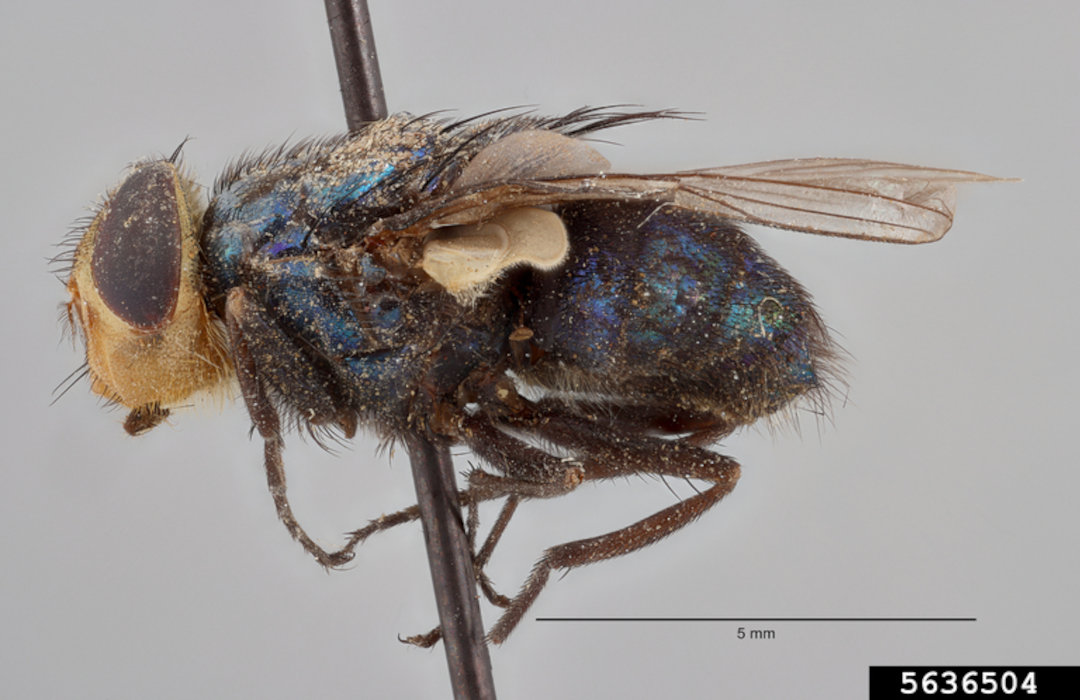
Adult New World screwworm. Image credit: Paul Langlois, New World screwworm and other calliphorids (Diptera), USDA APHIS PPQ, Bugwood.org
Prevention and preparedness
The best prevention is to reduce opportunities for flies to lay eggs.
Recommended steps include:
- Inspect animals regularly, especially during warm weather and after travel.
- Check newborn animals carefully, especially the navel area.
- Monitor recently castrated, branded, dehorned, tagged, or otherwise processed animals.
- Treat wounds promptly according to veterinary guidance.
- Maintain good sanitation and remove sharp objects from pens, trailers, and working facilities.
- Control ticks and other pests that create wounds.
- Observe pets, horses, and working animals after travel to areas with confirmed or suspected activity.
- Do not move animals with suspicious wounds until a veterinarian or animal health official provides guidance.

New World screwworm-infested navel on a young sheep. Newborn and young animals are at particular risk from New World screwworm because egg-laying females may be attracted to the navel area. Image credit: Sohath Yusseff-Vanegas, USDA Agricultural Research Service.
Treatment
Treatment decisions should be made by a veterinarian and may include removal of larvae, wound cleaning, supportive care, appropriate products for the animal species, and treatment of secondary infections. Because guidance may change during an active response, animal owners should not rely on informal treatment recommendations or attempt to manage suspect cases without veterinary involvement.
Area-wide response and sterile insect technique
New World screwworm was eradicated from the United States using the sterile insect technique, one of the major successes in applied entomology and animal health. This approach involves mass-rearing screwworm flies, sterilizing males, and releasing sterile males into affected areas. When wild females mate with sterile males, they do not produce viable offspring. Repeated releases can suppress and eliminate populations.
Sterile fly release, surveillance, quarantine, movement controls, wildlife monitoring, and rapid reporting remain central tools in the current response.
Colorado status and reporting
Colorado has activated preparedness and response planning following the confirmed detection of New World screwworm in Texas. There are no locally established New World screwworm populations known in Colorado at the time this page was prepared, but the situation is evolving quickly.
Report suspected cases immediately
Domestic animals: contact your veterinarian and the Colorado State Veterinarian’s Office.
Wildlife: contact Colorado Parks and Wildlife.
People: seek medical care and follow public health reporting guidance.
Recommended resources
Colorado and CSU resources
- CSU Veterinary Health: New World Screwworm: What you need to know
- Colorado Department of Agriculture: New World Screwworm reporting and preparedness
- Colorado Parks and Wildlife: reporting wildlife concerns
Federal resources
- USDA APHIS / Screwworm.gov: current situation, reporting, response, and identification resources
- USDA APHIS: New World Screwworm response and sterile fly information
- CDC: New World Screwworm outbreak information for the public and health care providers
Texas A&M AgriLife resources
Texas A&M AgriLife Extension has developed practical materials for livestock producers, wildlife managers, companion animal owners, public health professionals, and families, including Spanish-language resources. These are especially useful because the current U.S. detection was confirmed in Texas and Texas agencies are actively involved in response and outreach.
Recommended Texas A&M AgriLife resources include:
- New World screwworm information hub
- Livestock and cattle producer guidance
- Wildlife monitoring guidance
- Companion animal guidance
- Human health fact sheet
- Spanish-language materials
New Mexico State University resources
Need Insect Identification Help?
We offer agricultural insect identification services through our Plant Diagnostic Clinic and laboratory. We now charge a $15 identification fee. Please visit the Plant Clinic for sample submission instructions.